
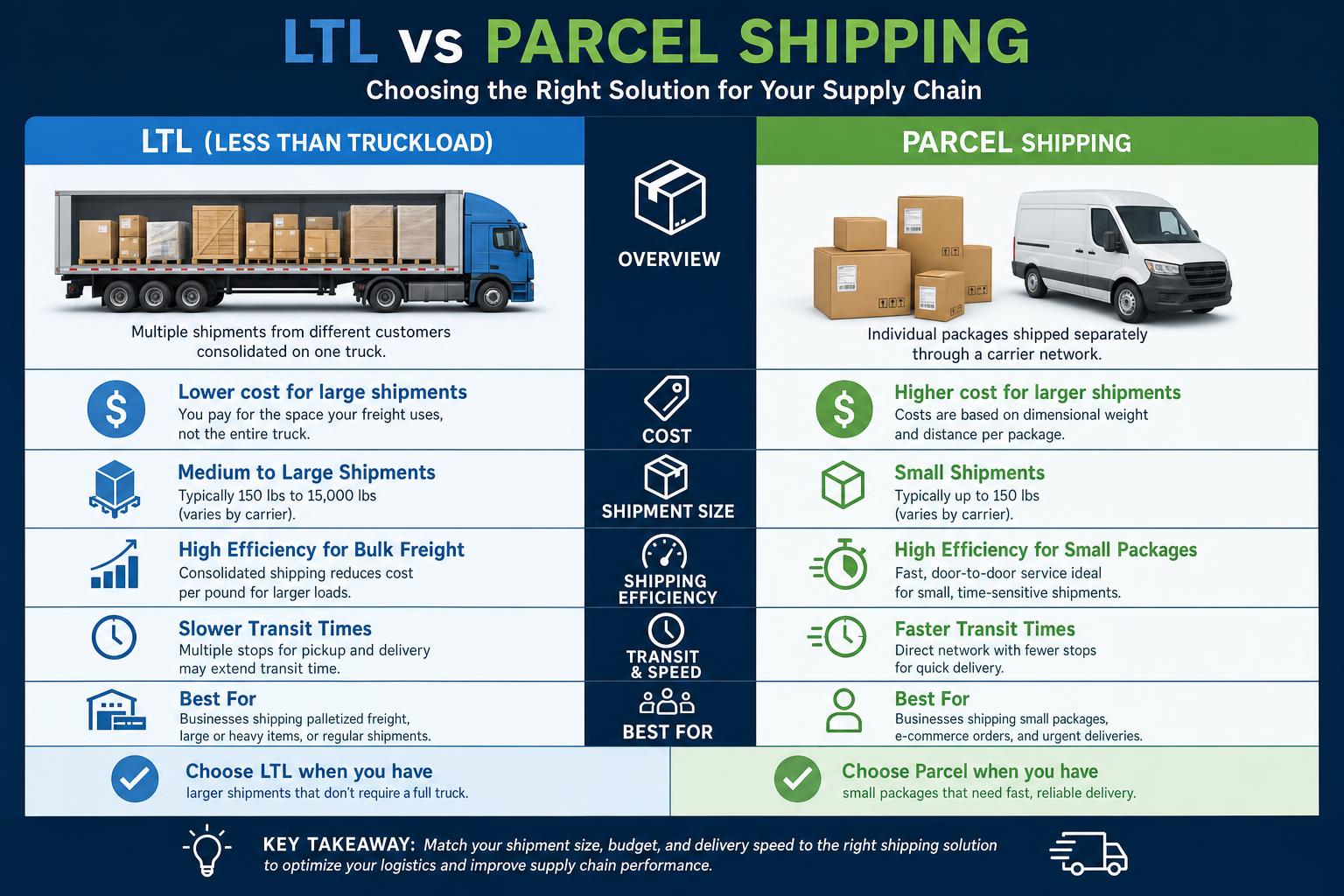
Choosing between Less Than Truckload (LTL) and parcel shipping comes down to one number: 150 pounds. Below that, parcel carriers like UPS, FedEx, and USPS are your default. Above it, LTL takes over — and the cost math shifts dramatically. This guide breaks down where each method fits, what the weight and dimension limits actually look like across major LTL carriers, and how a third option — partial truckload — fills the gap when your shipment outgrows LTL.
What is LTL Shipping?
LTL shipping is a freight transport method where your shipment shares trailer space with other shippers' freight. Carriers consolidate multiple loads into one truck, so you pay only for the space your cargo occupies. LTL handles dry freight up to about 20,000 lbs and 28 linear feet — beyond that, a partial or dedicated truckload is usually the better call. FSK's automated platform routes shipments to LTL when they're at or below 20,000 lbs and 28 linear feet (refrigerated freight at or below 10,000 lbs and 12 linear feet): standard LTL rates cover about the first 10,000 lbs and 12 feet, and volume LTL rates price the rest. LTL works best for palletized freight, crates, drums, and bags moving on standard dock-to-dock lanes. Use the linear feet calculator to confirm your shipment's footprint before requesting a quote.
What is Parcel Shipping?
Parcel shipping is designed for smaller packages, typically under 150 pounds. Major carriers — UPS, FedEx, USPS — handle individual boxes and small quantities with a range of delivery speeds. Costs scale with weight and size, and dimensional weight calculations (length × width × height ÷ 139 for domestic) can make large, light boxes surprisingly expensive. If you're shipping multiple boxes that together exceed 150 lbs, it's worth running an LTL quote for comparison. Use our dimensional weight calculator to see how parcel carriers price your package before you commit.
Key Differences Between LTL and Parcel Shipping
Here's how the two methods stack up across the factors that matter most:
- Weight Limits: LTL handles shipments from 150 lbs up to ~20,000 lbs of dry freight. Parcel is capped at 150 lbs per package (with some carriers accepting up to 150 lbs per piece for ground services).
- Cost Efficiency: LTL is almost always cheaper for shipments over 150 lbs — you pay for the space you use, not the whole truck. Parcel costs climb fast with weight and dimensions due to dimensional weight pricing.
- Delivery Speed: Parcel carriers offer overnight and two-day options on most lanes. LTL transit times are typically 1–5 business days depending on distance, with expedited and guaranteed options available. Use the shipping time calculator to estimate transit on your lane.
- Tracking and Visibility: Parcel tracking is near real-time. LTL tracking has improved significantly but varies by carrier — most provide scan events at origin, relay terminals, and destination.
- Handling: Parcel shipments move through more sort facilities and handling points, which raises damage risk for fragile goods. LTL freight typically stays on a pallet and moves through fewer touches.
- Service Types: LTL carriers offer standard, expedited, and guaranteed delivery. Parcel carriers offer ground, express, and overnight tiers.
Weight and Dimension Limits of LTL Carriers
Different LTL carriers publish different weight and dimension limits. The table below shows the published limits for major national carriers. Check the LTL carrier directory for current service maps and accessorial details.
| Carrier | Weight Limits | Dimension Limits |
|---|---|---|
| FedEx Freight | Up to 15,000 lbs total; individual pieces up to 4,000 lbs | Length up to 15 ft |
| Old Dominion Freight Line | Up to 15,000 lbs | Up to 12 ft length, 8 ft width |
| ABF Freight | Up to 15,000 lbs | Up to 12 ft length, 8 ft width |
| R&L Carriers | Up to 15,000 lbs | Up to 12 ft length, 8 ft width |
| TForce Freight | Up to 15,000 lbs | Up to 12 ft length, 8 ft width |
| Estes Express | Up to 15,000 lbs | Up to 12 ft length, 8 ft width |
| Saia LTL Freight | Up to 15,000 lbs | Up to 12 ft length, 8 ft width |
Note: Freight class — based on density, stowability, handling, and liability — also drives LTL pricing. A denser shipment earns a lower class number and a lower rate. Use our freight class estimator to calculate your class before requesting a quote, or read the full freight class guide for a deeper breakdown. Unfamiliar with terms like freight class, NMFC, or accessorials? The freight glossary has plain-language definitions.
How to Choose Between LTL and Parcel Shipping
Run through these four factors in order:
Shipment Size and Weight
- Under 150 lbs: parcel is almost always the right call.
- 150 lbs to ~20,000 lbs and 28 linear feet or less (dry freight): LTL is typically the most cost-effective option.
- 20,000–30,000 lbs or 28–32 linear feet: consider partial truckload — fewer handling events and often better pricing than LTL at that size. Partial moves on dry van, flatbed, or step deck depending on your freight.
- Over 30,000 lbs or 32+ linear feet: a dedicated truckload is the standard move.
Cost
- LTL costs are based on weight, freight class, and distance. Accessorials (liftgate, residential delivery, inside delivery) add to the base rate. See the service & equipment fees guide for a breakdown of common add-ons.
- Parcel costs increase sharply for heavier or bulkier packages. Dimensional weight — calculated as length × width × height ÷ 139 — often prices a large, light box higher than its actual weight would suggest.
Delivery Speed
- Parcel carriers offer next-day and two-day services on most domestic lanes.
- LTL transit is typically 1–5 business days. Expedited and guaranteed-delivery options are available from most national carriers for time-sensitive freight.
Handling and Damage Risk
- Parcel shipments pass through multiple sort facilities — more touches means more damage exposure for fragile items.
- LTL freight moves on pallets with fewer handling events, which generally means lower damage rates for properly packaged goods.
Freight Sidekick: Your Partner in Freight Shipping
Freight Sidekick is a freight logistics platform that arranges surface transportation across all 50 states, DC, and Canada. We don't handle parcel shipping — that's FedEx and UPS territory — but we cover every freight mode above the parcel threshold:
- LTL (Less-Than-Truckload): Palletized freight from 150 lbs to ~20,000 lbs and up to 28 linear feet (dry freight). Liftgate, residential delivery, and inside delivery options available.
- Partial / Shared Truckload: Dry shipments between 28–32 linear feet or 20,000–30,000 lbs (from 12 linear feet / 10,000 lbs for refrigerated freight). Bridges the gap between LTL and a dedicated truck — fewer handling events, often better rates at that size. Available on dry van, flatbed, and step deck.
- Full Truckload (FTL): Dry van, refrigerated, flatbed, step deck, and drop deck. Dedicated capacity for loads that fill a trailer.
- Specialized / Heavy Haul: RGNs, double drops, multi-axle trailers, and lowboys for over-dimensional and overweight freight with permit and escort coordination.
- Smaller Equipment: Box trucks, hotshots, and cargo vans for time-critical or hard-to-access deliveries.
Our self-serve quoting platform pulls instant rates from our full carrier network — no callbacks, no waiting. The system reads your weight, dimensions, and equipment requirements and routes your shipment to the right rate engine automatically. Dedicated account managers handle the edge cases.
Conclusion
The parcel-vs-LTL decision is mostly a weight question: under 150 lbs, ship parcel; over 150 lbs, get an LTL quote. For dry shipments pushing past 20,000 lbs or 28 linear feet, run a partial truckload comparison — the rate and service difference is often significant. Freight Sidekick can quote all three modes in one place, so you're not guessing which option wins.
Get Personalized Assistance
Get a quote today, call us at 877-345-3838 or email support@freightsidekick.com.


