
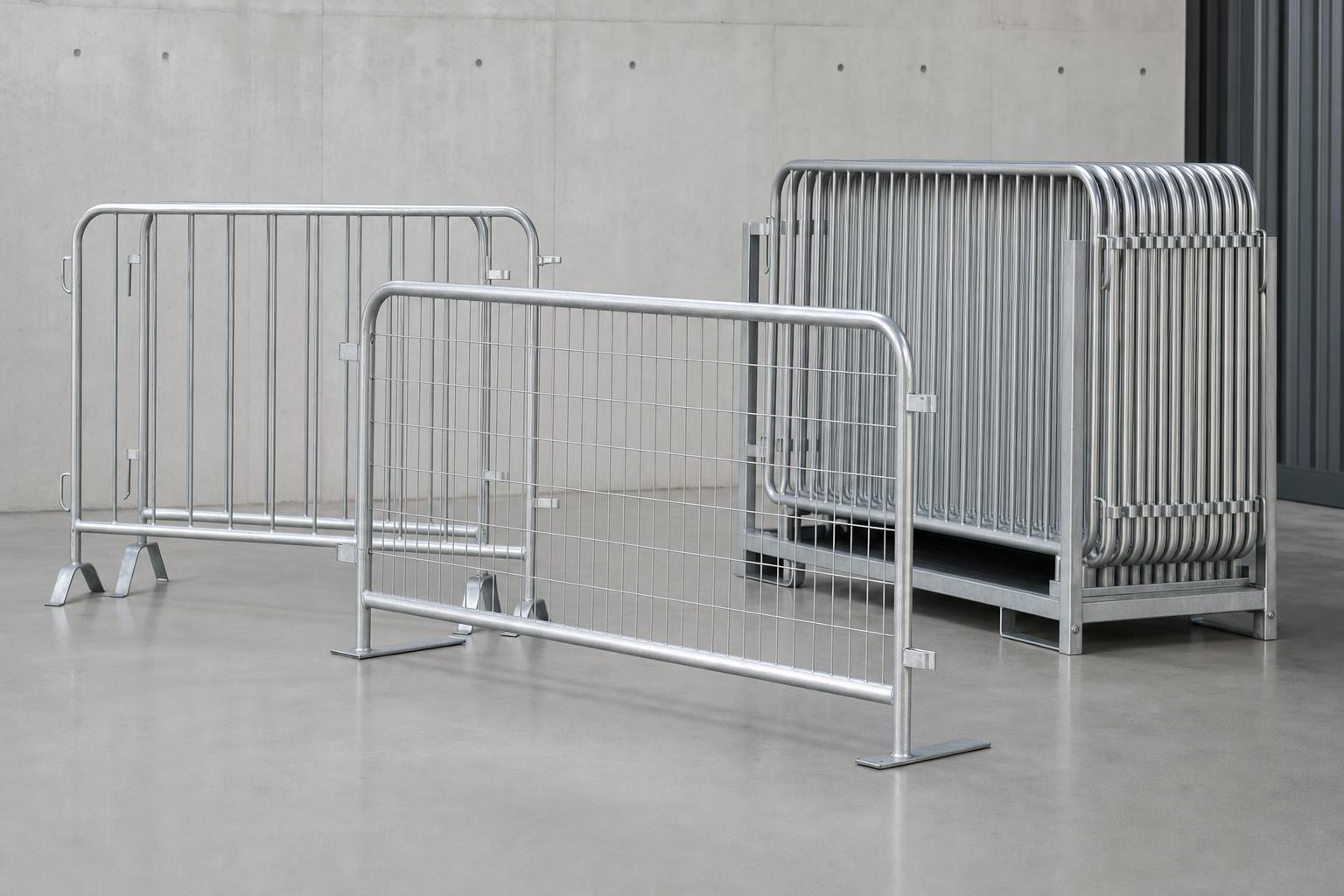
Shipping Portable Fencing & Barricades: LTL vs. Full Truckload
You've got 200 panels of portable crowd-control fencing sitting in a warehouse in Atlanta. The job site — a music festival in Dallas — needs them in four days. Do you call an LTL carrier, book a partial, or pull a dedicated truck? Get it wrong and you're either overpaying by $1,200 or watching your freight sit at a terminal for two extra days while the event crew scrambles.
Portable fencing and barricades aren't complicated freight — but they have specific physical traits that make mode selection matter more than it does for a standard pallet of boxed goods. The panels are long, they're often stackable but awkward, and they almost always ship in volume. Here's how to think through the decision.
The Decision Framework at a Glance
Before diving into each mode, here's the quick-reference table. Match your shipment to the column that fits, then read the section below for the full picture.
| Factor | LTL | Partial / Shared Truckload | Full Truckload (FTL) |
|---|---|---|---|
| Shipment size | 1–12 linear ft, ≤10,000 lbs | 12–32 linear ft, 10,000–30,000 lbs | >32 linear ft OR >30,000 lbs |
| Typical panel count (standard 8 ft panels) | ~10–40 panels | 40–120 panels | 120+ panels |
| Cost structure | Pay per pallet / cwt | Pay per linear foot of trailer | Pay for the whole truck |
| Transit time | 2–5 days (terminal network) | 2–4 days (fewer stops) | 1–3 days (direct) |
| Handling risk | Higher (multiple terminal touches) | Moderate (1–2 transfers max) | Lowest (driver-to-driver) |
| Equipment options | Dry van only | Dry van, flatbed, step deck | Dry van, flatbed, step deck |
| Best for | Small restocking orders, samples | Mid-size event deployments | Large events, full inventory moves |
What Makes Portable Fencing Freight Unique
Portable fencing — whether you're moving crowd-control barricades, temporary construction fence panels, water-filled jersey barriers, or interlocking plastic barricades — shares a few traits that shape every shipping decision:
- Long and flat. Standard crowd-control panels run 8–10 feet long. Even stacked, a pallet of 20 panels can easily hit 8–10 feet in length — which eats linear feet fast on an LTL carrier's floor.
- Heavy for the footprint. Steel barricades weigh 35–55 lbs each. A pallet of 40 steel panels can hit 1,600–2,200 lbs. That density matters for freight class.
- Often stackable — but carefully. Panels stack well when bundled, but loose stacking invites damage. Proper banding and corner protection are non-negotiable.
- Frequently time-sensitive. Event and construction deployments have hard deadlines. A barricade shipment that arrives the morning of setup day has zero buffer for a terminal delay.
- Usually shipped in quantity. Rarely does anyone ship 5 panels. Orders of 50, 100, or 500 panels are common — which means you're almost always evaluating partial or truckload, not just LTL.
Freight Class for Portable Fencing & Barricades
If you're shipping LTL, you need a freight class. The good news: steel and metal barricades are dense, which means a low freight class — and lower LTL rates.
Here's a quick example. A pallet of 40 steel crowd-control panels, each 8 ft × 3 ft × 3 in and weighing 45 lbs each:
- Total weight: 40 × 45 lbs = 1,800 lbs
- Pallet dimensions (stacked): 96" L × 36" W × 48" H
- Cubic feet: (96 × 36 × 48) / 1,728 = 96 ft³
- Density: 1,800 / 96 = 18.75 lb/ft³ → Class 70
Class 70 is a favorable class — you're not paying the penalty rates that low-density freight like foam or plastic barricades might attract. Lighter plastic or water-filled barriers can drop to 6–8 lb/ft³ when empty, pushing them toward Class 125 or higher. Always calculate density on the actual loaded weight. Use the freight class estimator to confirm before booking.
One more thing: if your barricades are oddly shaped or don't stack cleanly, LTL carriers may apply a density exception or re-weigh the shipment at the terminal. Tight banding and consistent pallet dimensions protect you from surprise reclassifications.
When LTL Makes Sense for Fencing & Barricades
LTL works when your shipment is small enough to fit within 12 linear feet of trailer space and stays under 10,000 lbs. For portable fencing, that typically means smaller replenishment orders — a few dozen panels going to a rental yard, a single pallet of pedestrian barricades for a small event, or a sample order for a new customer.
The appeal is straightforward: you share the truck with other shippers, so you only pay for the space you use. On a 500-mile lane, a single pallet of steel panels at Class 70 might run $180–$320 depending on the carrier and lane. That's hard to beat if you genuinely only need 20 panels.
The catch: LTL freight moves through a terminal network. Your pallet gets loaded, unloaded, sorted, and reloaded — sometimes two or three times — before it reaches the consignee. For barricades, that means more opportunities for panels to shift, bend, or get separated from their banding. Invest in proper pallet construction: band the panels tightly, use edge protectors at the corners, and shrink-wrap the entire pallet before it leaves your dock.
Transit time on LTL runs 2–5 business days for most lanes. If your event is in 72 hours, LTL is a gamble. Use the shipping time calculator to check realistic transit windows before you commit.
One more LTL consideration: most LTL carriers operate enclosed dry vans. That's fine for most barricades, but if your panels are too long to fit through a standard dock door (some 12-ft panels won't), you'll need to flag that upfront or the carrier will refuse the freight at pickup.
When Partial Truckload Is the Right Call
This is the mode most fencing shippers overlook — and it's often the best fit. Partial truckload (also called shared truckload) covers shipments between 12 and 32 linear feet of trailer space, typically weighing 10,000–30,000 lbs. For portable fencing, that's roughly 40–120 standard panels per load.
Here's why partial often wins for mid-size fencing orders:
- Fewer terminal touches. Partial loads move with at most one or two other shippers on the same truck — far less handling than LTL's terminal-to-terminal relay.
- Open-deck options. Unlike LTL (enclosed-only), partials can run on flatbeds or step decks. If your panels are oversized or you need forklift access from the side, a flatbed partial is the answer.
- Better pricing than FTL for mid-size loads. You're paying for the linear feet you use, not the whole truck. A 20-linear-foot partial on a 600-mile lane might run $900–$1,400 — versus $2,200–$2,800 for a dedicated truck.
- Faster than LTL. Partial loads typically deliver in 2–4 days with fewer stops.
The partial mode is especially useful for event rental companies that ship 80–100 panels to a venue, then need them back. The outbound move is a partial; the return move is a partial. You're never paying for empty space on a dedicated truck, and you're not gambling on LTL transit times with a hard event date.
Not sure if your load qualifies as partial? Measure the total linear feet your freight will occupy on the trailer floor. A stack of 80 panels at 8 ft each, bundled into 4 pallets of 20, might occupy 16–20 linear feet. That's solidly in partial territory. Use the linear feet calculator to get an accurate number before you quote.
When Full Truckload Is Worth Every Dollar
Full truckload makes sense when your shipment exceeds 32 linear feet or 30,000 lbs — or when the deadline is so tight that you can't afford any shared-space risk. For portable fencing, that means large event deployments (think 500+ panels for a stadium perimeter), full inventory moves between warehouses, or construction projects requiring hundreds of jersey barriers delivered to a single site.
A dedicated 53-foot dry van holds roughly 45,000 lbs and 53 linear feet of freight. A flatbed holds 48,000 lbs on a 48-foot deck. For fencing, the flatbed is often the better choice: panels can be loaded from the side by forklift, strapped down without the constraints of a dock door, and unloaded at job sites that don't have a loading dock.
The economics flip at scale. If you're filling 28+ linear feet of a truck, you're paying for most of it anyway under partial pricing. At that point, booking a dedicated truck often costs only $200–$400 more — and you get direct service, no co-loading, and a driver who's focused entirely on your freight. On a 1,000-mile lane, a dedicated flatbed for 300 panels might run $2,800–$3,600. That's roughly $9–$12 per panel delivered. Hard to argue with when the alternative is a partial that might cost $2,200 with slightly more transit risk.
FTL also gives you multi-stop flexibility. If you need panels delivered to three different venues along a route — say, Chicago to Indianapolis to Cincinnati — a dedicated truck handles that cleanly. LTL carriers don't support multi-stop, and partial truckload multi-stop adds complexity. See the multi-stop route planner to map out the most efficient delivery sequence.
Choosing the Right Equipment: Dry Van vs. Flatbed
Most portable fencing ships just fine in a dry van. Panels are weather-tolerant (they live outside, after all), and enclosed trailers are the default for LTL and most partial moves. But there are situations where open-deck equipment — flatbed or step deck — is the smarter call:
- Panels longer than 8.5 feet. A standard 53' dry van has an interior height of 9 feet and a rear door opening of roughly 8.5 feet wide. Very long panels (10–12 ft) may not fit through the door. A flatbed eliminates that constraint entirely.
- Delivery to a job site without a dock. Construction sites rarely have loading docks. A flatbed lets a forklift or telehandler unload from the side. A dry van requires a liftgate or a dock — neither of which is guaranteed on a job site.
- Heavy or bulky loads that benefit from crane loading. Water-filled jersey barriers and concrete barricades are sometimes crane-loaded. That's only practical on open-deck equipment.
- Oversized or non-standard configurations. If your barricades are stacked on custom frames or loaded on specialized racks that exceed 9 feet in height, you're looking at step deck or flatbed territory.
For standard crowd-control panels and pedestrian barricades under 8 feet, a dry van is fine and usually cheaper. For construction-grade barriers, jersey barriers, or any load heading to a site without dock access, request a flatbed. Check out the full flatbed freight service and step deck service pages for equipment specs.
Packaging, Securing, and Documentation
Barricades and fencing panels are durable — but they're also heavy, metal, and prone to shifting. A load that moves in transit can damage the panels themselves, damage other freight sharing the truck, or create a safety hazard. Here's what proper preparation looks like:
- Band and bundle tightly. Use steel or heavy-duty poly banding to secure panels into stable bundles. Don't rely on shrink wrap alone for steel panels — it won't hold under the weight.
- Pallet or skid the load. Even if panels are bundled, placing them on a pallet or skid makes forklift handling cleaner and reduces terminal damage. Secure the bundle to the pallet with banding through the pallet deck.
- Use edge protectors. Metal panels have sharp corners that cut through banding and damage adjacent freight. Cardboard or plastic edge protectors at every corner are cheap insurance.
- Label clearly. Each pallet or bundle should have a shipping label with origin, destination, PRO number (for LTL), and piece count. For FTL, label each bundle individually in case freight gets separated.
- Document the condition at pickup. Take photos before the driver leaves. If there's a damage claim later, photos at origin are your strongest evidence.
For LTL shipments, generate your Bill of Lading before pickup using the BOL generator. Make sure the freight class, piece count, and weight are accurate — discrepancies at the terminal trigger re-weigh fees and potential reclassification charges.
Timing, Seasonality, and Event Logistics
Portable fencing has a pronounced seasonal demand curve. Spring through fall — festival season, outdoor construction, sporting events — is when everyone needs panels at the same time. That creates two problems: carrier capacity tightens, and transit times stretch.
A few rules that hold up in practice:
- Book 5–7 days ahead for LTL during peak season. In spring and summer, LTL transit times on busy lanes can run a day longer than the published schedule. Build in buffer.
- Book 3–5 days ahead for partial and FTL. Carrier availability for flatbeds tightens in construction season (April–October). Waiting until 48 hours before pickup often means paying a premium or accepting a less-than-ideal carrier.
- For hard deadlines, go FTL. If the event starts Saturday at 8 AM and the panels must be there Friday afternoon, a dedicated truck is the only mode that gives you real control over the delivery window.
- Consider the return move. Event rental companies often forget to plan the pickup. A truck that drops 300 panels on Friday needs to be booked to pick them up Sunday. Coordinate both legs upfront — it's often cheaper to hold the truck than to rebook.
If you're managing a recurring event circuit — same venues, same panel counts, rotating schedule — that's a project freight conversation. Freight Sidekick's team handles multi-shipment logistics programs with a dedicated project manager, so you're not re-quoting every leg from scratch. Learn more at freight project management.
The mode-selection logic here applies broadly to other construction and event materials. For a parallel look at how these decisions play out with a different commodity, see the peer article on efficient shipping for construction adhesives — the LTL vs. FTL framework transfers directly.
Common Mistakes — and How to Avoid Them
- Defaulting to LTL because it's familiar. If your load is 15 linear feet and 12,000 lbs, LTL will quote it — but it'll be expensive and slow. A partial truckload will likely be cheaper and faster. Always compare modes before booking.
- Not measuring linear feet. LTL carriers charge by weight and class. Partial and truckload carriers charge by linear feet. If you don't know your linear feet, you can't compare apples to apples. Measure the trailer floor space your freight will occupy, not just the pallet dimensions.
- Booking dry van when the site needs a flatbed. Arriving at a job site with a dry van and no dock is a problem. Confirm the delivery location's unloading capability before you book equipment.
- Underestimating freight class for plastic barricades. Empty plastic barricades are very light for their size — density can drop to 4–6 lb/ft³, pushing them to Class 175 or higher. That's a significant LTL rate driver. Ship them filled (if water-fillable) or consolidate tightly to improve density.
- Not accounting for accessorial charges. Liftgate delivery, residential delivery, limited access (job sites often qualify), and inside delivery all add to LTL invoices. Get the full accessorial picture before you compare LTL to partial pricing.
Get a Rate on Your Fencing or Barricade Shipment
Whether you're moving 20 panels across two states or 500 panels to a festival site on a hard deadline, Freight Sidekick can quote LTL, partial truckload, and full truckload — including flatbed and step deck options — in one place. Get an instant rate at freightsidekick.com/freight-quote, or reach the team directly at 877-345-3838 or support@freightsidekick.com. If you're coordinating a recurring event circuit or a large-scale deployment, submit an RFP and a project manager will reach out to scope the full program.


