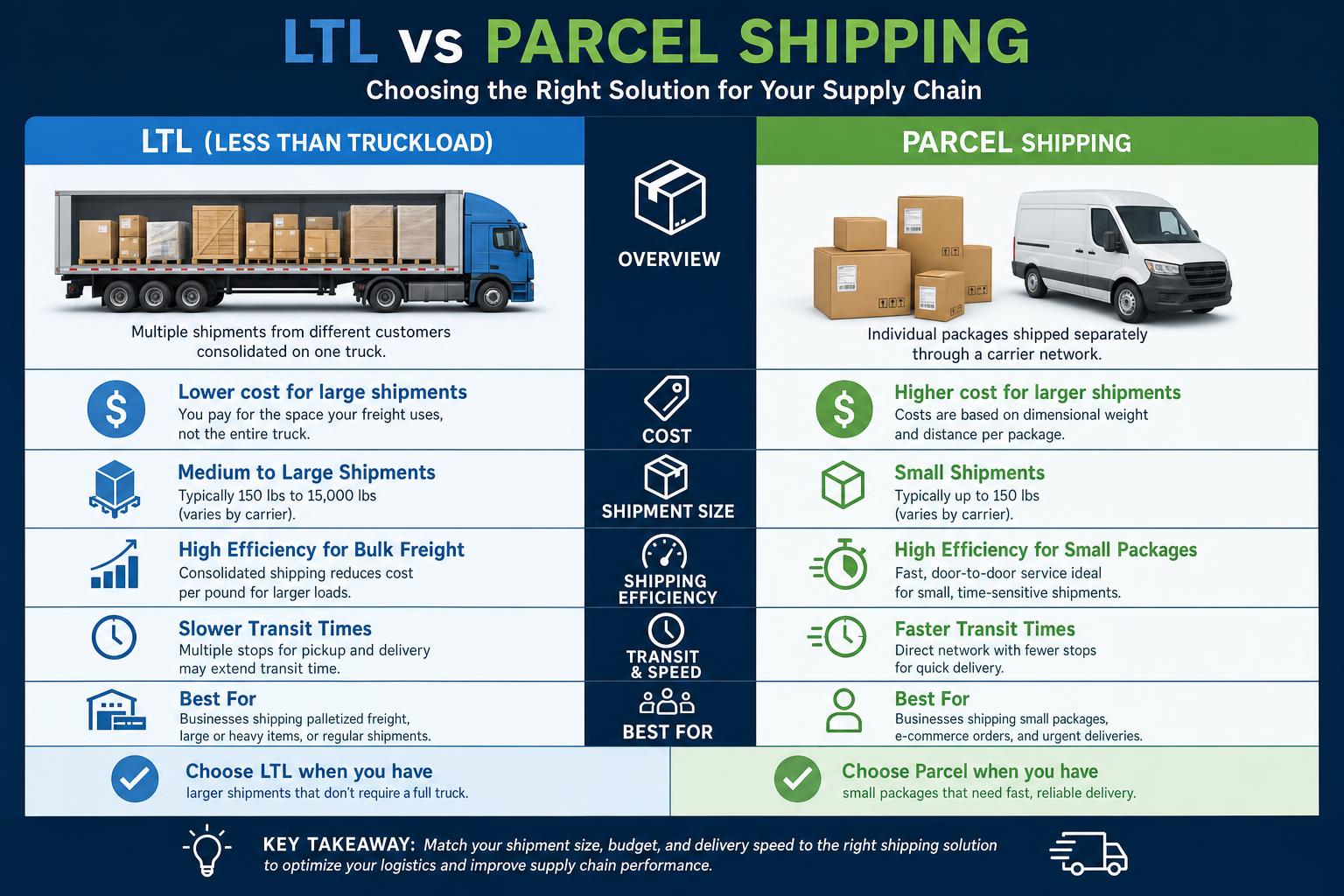
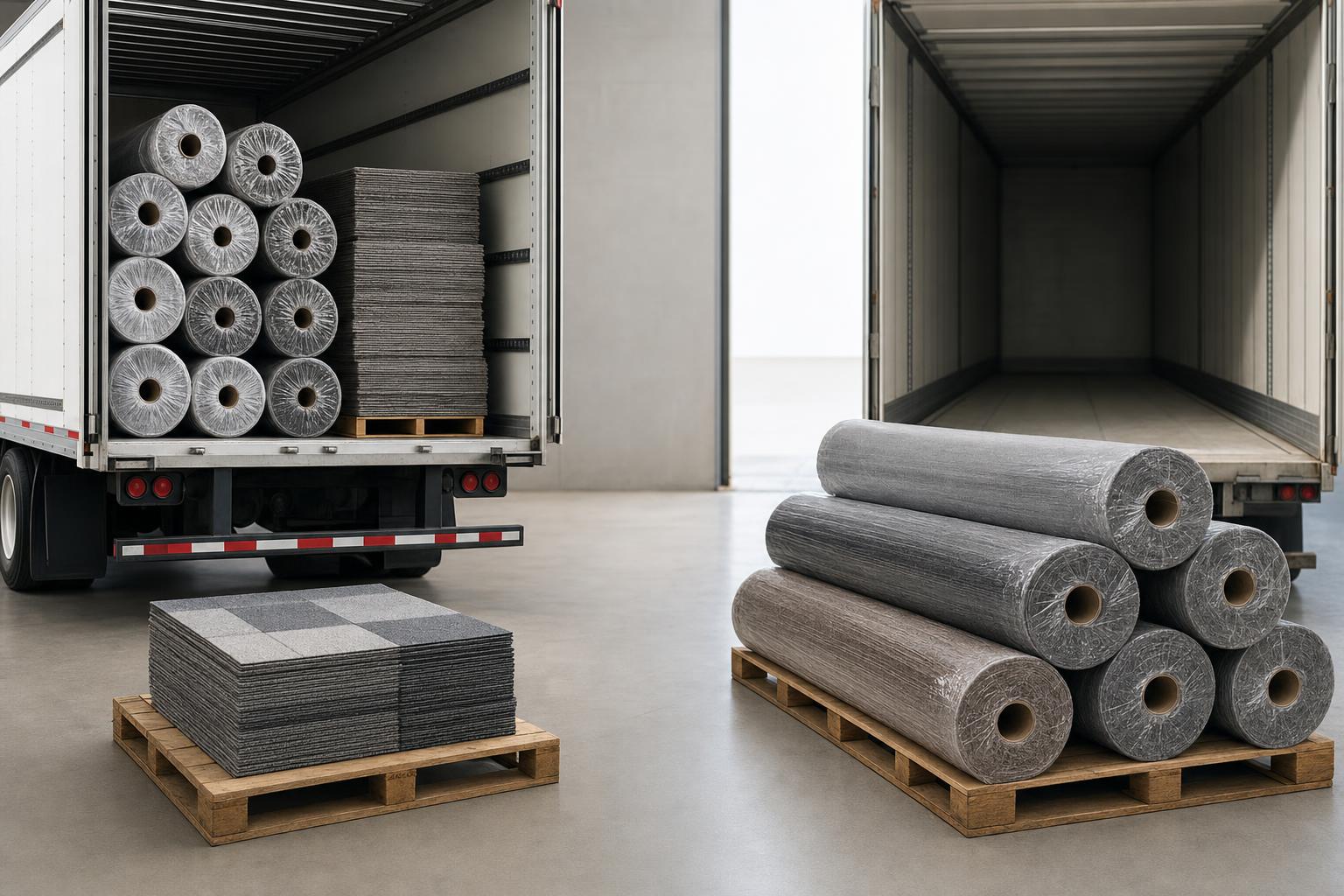
Carpet is one of those commodities that looks simple until you're actually booking the truck. A roll of commercial broadloom can run 12 feet wide and weigh 1,800 lbs. A pallet of carpet tiles stacks neatly but can hit 2,500 lbs before you've loaded half the order. Get the mode wrong and you're either paying for 48 linear feet of trailer you didn't need, or watching your rolls get cross-docked three times through an LTL terminal network that wasn't designed for 12-foot cylinders.
The Decision Framework at a Glance
Before diving into the details, here's how the three modes stack up for carpet and flooring shipments:
| Factor | LTL | Partial Truckload | Full Truckload (FTL) |
|---|---|---|---|
| Typical shipment size | 1–6 rolls or 1–8 pallets of tiles (≤12 linear ft, ≤10,000 lbs) | 7–20 rolls or 9–24 pallets (12–32 linear ft, 10,000–30,000 lbs) | Full mill order, multi-room commercial job, or 20+ rolls (>32 linear ft or >30,000 lbs) |
| Cost structure | Pay for space used; shared trailer cost | Pay for linear feet reserved; no co-mingling | Pay for the whole truck regardless of fill |
| Transit time | 2–5 days (hub-and-spoke network) | 2–4 days (fewer stops than LTL) | 1–3 days (direct, door-to-door) |
| Handling events | 3–6 touches (terminal transfers) | 1–2 touches | 1 touch (driver picks up, driver delivers) |
| Damage risk for rolls | Higher — rolls can be stood upright or crushed at terminals | Low — dedicated space, no co-mingling | Lowest — driver owns the load start to finish |
| Minimum order | No minimum (150 lbs) | ~10,000 lbs practical floor | No minimum, but cost-effective at 20,000+ lbs |
| Best for | Sample orders, small replenishment, tile pallets under 8,000 lbs | Mid-size commercial installs, regional distribution runs | Mill-direct orders, large hotel/office builds, full container equivalents |
What Makes Carpet Freight Uniquely Tricky
Most palletized freight is forgiving. A box of hardware or a drum of resin sits on a 48×40 pallet, gets shrink-wrapped, and loads like every other pallet in the trailer. Carpet doesn't work that way.
Carpet rolls (broadloom) ship as large cylinders — typically 12 feet wide and rolled to 4–6 inches in diameter for residential grades, up to 12–14 inches for commercial-weight goods. A single roll of 6-lb commercial carpet, 12 ft × 100 ft, weighs roughly 1,400–1,800 lbs. Stack two rolls and you're already at 3,600 lbs and consuming 12+ linear feet of trailer floor. The geometry matters: rolls laid horizontally need to be properly blocked and braced so they don't shift. Rolls stood on end — which some LTL terminals do when space is tight — can permanently deform the pile.
Carpet tiles are a different animal. A standard 24×24-inch modular tile weighs about 2.5–4 lbs per tile. A case of 48 tiles runs 120–192 lbs. Stack 20 cases on a pallet and you're at 2,400–3,840 lbs — dense, stable, and forklift-friendly. Tiles ship much more like conventional palletized freight. The challenge is quantity: a 10,000-square-foot commercial installation might need 2,500 tiles (52 cases), which is 12,480–19,968 lbs across 3–5 pallets. That's right at the LTL/partial boundary.
The other factor: moisture. Carpet absorbs humidity. A roll sitting in an open LTL terminal dock in Houston in August can arrive at a Denver job site with a moisture content that causes buckling after installation. Enclosed dry van trailers solve this — but only if the freight isn't sitting on a terminal dock for 36 hours between legs.
Freight Class for Carpet: What You'll Actually Pay
For LTL shipments, freight class drives your rate. Carpet's class is determined by density — and carpet density varies significantly by product type. Here's the formula:
Density (lb/ft³) = Total Weight ÷ Total Cubic Feet
Cubic Feet = (Length × Width × Height in inches) ÷ 1,728
Let's run two real examples. A residential carpet roll: 144 inches long × 12 inches diameter (roughly 6-inch radius, so height = 12 in) × 12 inches wide. Cubic feet = (144 × 12 × 12) ÷ 1,728 = 12 ft³. Weight: 400 lbs. Density = 400 ÷ 12 = 33.3 lb/ft³ → Class 60. A commercial-weight roll: same dimensions but 1,600 lbs. Density = 1,600 ÷ 12 = 133 lb/ft³ → Class 50. Carpet tiles on a pallet: 48×40×48-inch pallet, 2,800 lbs. Cubic feet = (48 × 40 × 48) ÷ 1,728 = 53.3 ft³. Density = 2,800 ÷ 53.3 = 52.5 lb/ft³ → Class 50.
Class 50 is the lowest (and cheapest) LTL class. Dense commercial carpet and well-stacked tile pallets often land there. Lighter residential rolls can drift to Class 60 or 65 — still reasonable, but worth calculating before you book. Use the freight class estimator to run your specific dimensions and weight before committing to a carrier quote.
One important note: in LTL, if the carrier re-weighs or re-measures your shipment at the terminal and finds a different density than what you declared, they'll reclassify and invoice the difference — sometimes with a penalty. Measure accurately. For rolls, measure the actual diameter, not the nominal size.
When LTL Makes Sense for Carpet
LTL is the right call when your shipment is small enough that paying for a dedicated truck would be wasteful. For carpet, that means:
- Sample orders and small replenishment runs — 1–3 rolls or 1–4 pallets of tile, under 5,000 lbs total
- Carpet tiles going to a single commercial address with a loading dock — tiles are stackable, dense, and handle LTL terminal transfers well
- Residential broadloom for a single room — a 12×15 ft room needs one roll; that's 400–800 lbs, well within LTL range
- Shipments under 10,000 lbs and 12 linear feet — FSK's system auto-routes these to LTL pricing
The tradeoff: LTL freight moves through a hub-and-spoke network. Your rolls might transfer through 2–3 terminals before reaching the destination. Each transfer is a handling event — and each handling event is an opportunity for a roll to get stood on end, crushed against a wall, or exposed to a dock that's 90°F and 80% humidity. For high-value commercial carpet going to a finished installation, that's a real risk.
If you're shipping LTL, document your rolls' condition before pickup with photos. Note any existing packaging damage on the Bill of Lading at delivery. Carriers limit liability on LTL claims — knowing your freight class and declared value matters. See the BOL generator to get your paperwork right the first time.
Also check whether your delivery address needs a liftgate. Most carpet distributors and commercial job sites have docks. Residential deliveries — a homeowner getting broadloom for a basement remodel — almost always need a liftgate, which adds $75–150 to the accessorial charges. Flag it upfront; forgetting it means the driver can't offload and you get a re-delivery fee on top.
When Partial Truckload Is the Sweet Spot
Partial truckload (also called shared truckload) is the mode most carpet shippers don't know about — and it's often the best fit for mid-size commercial orders.
The math: a partial shipment occupies 12–32 linear feet of a 53-foot dry van and weighs 10,000–30,000 lbs. You're paying for the space you use, not the whole truck. But unlike LTL, your freight doesn't get cross-docked at terminals. The driver picks it up, it rides in a dedicated section of the trailer, and it delivers — typically with just 1–2 handling events total.
For carpet rolls, this is significant. A partial shipment of 8–15 commercial rolls (roughly 12,000–22,000 lbs, 16–24 linear feet) moves with far less damage risk than the same load through LTL. The rolls stay blocked and braced as loaded. Nobody at a terminal is rearranging them to fit another shipper's freight.
Real scenario: a flooring contractor in Atlanta wins a 15,000-square-foot hotel lobby project and needs 18 rolls of commercial carpet from a mill in Dalton, Georgia, delivered to a job site in Nashville. Total weight: 28,000 lbs. Total linear feet: ~22 ft. That's a textbook partial — too big for LTL, no reason to pay for a full 53-foot truck. Partial truckload saves roughly 20–35% versus FTL on that lane. Use the linear feet calculator to confirm your load's footprint before quoting.
One edge case: if your shipment is near the LTL boundary (say, 13 linear feet and 11,000 lbs), compare both rates. Sometimes LTL comes in cheaper on short lanes under 300 miles. FSK's quoting system surfaces this automatically — it'll flag when a partial-sized load might price better as LTL.
When Full Truckload Is the Right Call
Full truckload means one shipper, one truck, one driver, one destination. The economics flip in your favor once you're filling more than about 28–32 linear feet of trailer, or when the cargo value and damage risk make a dedicated truck worth the premium even on a smaller load.
Carpet scenarios that call for FTL:
- Mill-direct orders for large commercial projects — a 50,000 sq ft office build might need 40+ rolls, easily filling a 53-foot dry van to 40,000 lbs
- High-value carpet going to a time-sensitive installation — a hotel opening on a fixed date can't afford a 2-day LTL delay; FTL gives you a committed pickup and a direct run
- Mixed flooring loads — rolls plus tile plus underlayment plus adhesive all going to one job site; FTL keeps it together and avoids the complexity of coordinating multiple LTL shipments
- Shipments over 30,000 lbs or 32 linear feet — FSK's system auto-routes these to truckload pricing
- Fragile or specialty carpet — hand-knotted wool rugs, custom-dyed broadloom, or any product where a single damage claim would exceed the cost difference between LTL and FTL
Equipment for carpet FTL is almost always a 53-foot dry van. Enclosed, weather-protected, dock-height for easy loading. The driver backs up to your dock, the rolls get loaded horizontally and blocked, and that's how they ride all the way to the destination. No terminal. No strangers touching your freight.
On long hauls (Chicago to Los Angeles, for example), FTL transit is typically 3–4 days. Compare that to LTL on the same lane: 5–7 days, with 4–5 terminal transfers. For a job site with a hard installation date, the transit time difference alone often justifies FTL.
Packaging and Loading: Where Carpet Claims Start
Regardless of mode, how you package and load carpet determines whether it arrives in sellable condition.
Rolls: Wrap the ends with kraft paper or plastic end caps to prevent fraying. Wrap the full roll in stretch film or poly wrap to protect against moisture and abrasion. Load horizontally — never vertically — and block with lumber or foam wedges to prevent rolling. In LTL, mark the roll clearly: "DO NOT STAND ON END" and "THIS SIDE UP" in large letters. Carriers aren't legally required to follow handling instructions, but it reduces the odds of mishandling and strengthens a damage claim if something goes wrong.
Tiles: Cases should be stacked on 48×40 pallets, banded, and stretch-wrapped. Don't exceed 60 inches in stack height — tile cases can shift and topple at 65+ inches when a driver brakes hard. Corner boards on the pallet add stability and protect edges. For LTL, make sure each pallet is individually wrapped; co-mingling tile cases from different pallets at a terminal is how you end up with a short shipment and a claims headache.
One thing that catches shippers off guard: LTL carriers can reject a shipment at pickup if the packaging doesn't meet their standards. A roll with no end protection or a pallet that's not stretch-wrapped may get refused — or worse, accepted and then damaged with a claim denial citing "inadequate packaging." Get it right before the driver shows up.
Accessorial Charges to Watch For
Carpet shipments attract accessorial charges more often than shippers expect. Here's what to flag when booking:
- Liftgate at pickup or delivery ($75–150): Required if either location doesn't have a loading dock. Most job sites don't. Most distribution centers do.
- Residential delivery ($75–200): If the delivery address is a home or home-based business, expect this charge plus a liftgate requirement.
- Limited access ($75–200): Construction sites, schools, churches, and storage facilities often qualify. Confirm with your carrier before booking.
- Inside delivery ($100–300+): If the driver needs to bring rolls past the threshold — into a building, up stairs, or to a specific room — that's inside delivery. Most LTL carriers don't offer it; you'll need a specialized carrier or a separate delivery crew.
- Appointment delivery ($50–100): Job sites often require a specific delivery window. Most carriers charge for this.
- Detention ($50–100/hr after 2 free hours): Have your crew ready. A 20-roll delivery that takes 3 hours to unload because you're short-staffed will cost you.
These charges add up fast. A $650 LTL quote can become a $1,100 invoice after liftgate, residential, and appointment fees. Get the full picture before you book. The service and equipment fees guide breaks down what's typical across carriers.
The Quick-Reference Decision Guide
Here's how to make the call in under 60 seconds:
- Measure your load. Count rolls or pallets. Estimate total weight and linear feet. Use the linear feet calculator if you're unsure.
- Apply the breakpoints: ≤12 linear ft AND ≤10,000 lbs → LTL. 12–32 linear ft OR 10,000–30,000 lbs → Partial. >32 linear ft OR >30,000 lbs → Truckload.
- Check the damage risk. High-value commercial carpet, tight installation deadlines, or rolls that can't tolerate terminal handling? Step up a mode.
- Check the delivery location. No dock? Add liftgate. Residential address? Add residential delivery. Construction site? Check limited access.
- Calculate freight class for LTL shipments using the density formula. Confirm it before booking — reclassification fees hurt.
- Compare rates across modes when you're near a boundary. A 13-linear-foot shipment at 11,000 lbs might price better as LTL on a short lane.
The same mode-selection logic applies to other building materials with awkward dimensions. If you're also moving portable fencing, barriers, or other construction-site goods on the same project, see the guide to shipping portable fencing and barricades — the LTL vs. partial breakpoints work the same way.
Freight Sidekick arranges LTL, partial truckload, and full truckload for flooring and building materials across all 50 states and Canada. The LTL freight service covers palletized carpet tiles and smaller roll shipments with instant online rates. For mid-size and large commercial orders, the partial and truckload rate engines handle the quoting automatically — you enter your dimensions and weight, the system picks the mode. No phone tag required for standard lanes.
Get a Rate on Your Carpet Shipment
Whether you're moving a single roll of residential broadloom or a full truckload of commercial carpet tiles to a job site, Freight Sidekick can quote it. Instant rates for LTL and truckload — no callbacks, no waiting. For larger or more complex flooring projects, reach out directly.
Get an instant freight quote →
Call us at (877) 345-3838 or email support@freightsidekick.com. We're available Monday–Friday 5 AM–5 PM PT and Saturday 9 AM–1 PM PT.