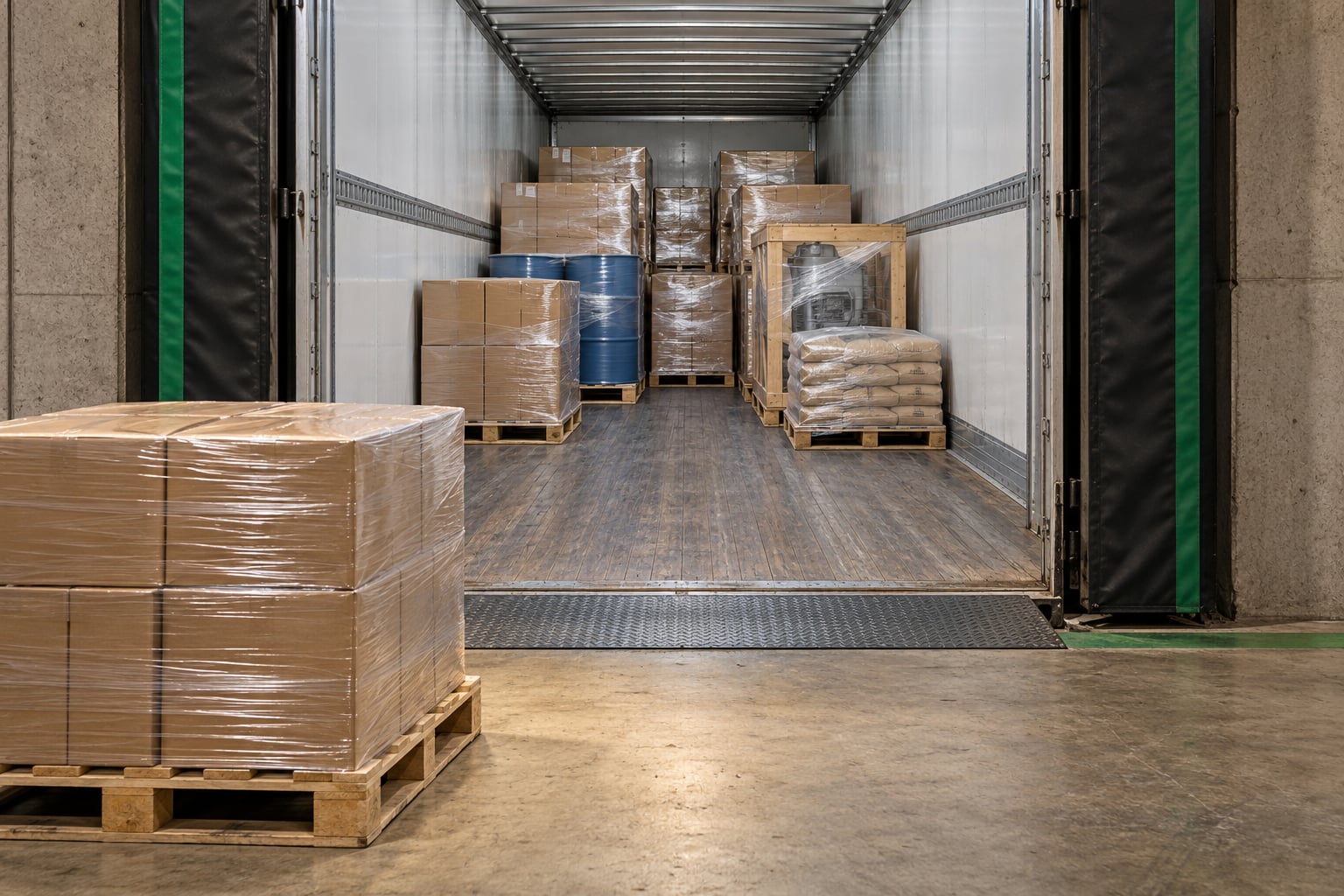

An LTL shipment is loaded, unloaded and moved between terminals several times before it's delivered, so how it's packed decides whether it arrives intact. This guide covers FedEx Freight's size and weight limits and how to pack a shipment that meets them.
FedEx Freight size and weight limits
From FedEx Freight's current packing guide:[1]
- Shipment: up to 20,000 lb and up to 20 feet long.
- Heavy units: for any single unit over 3,500 lb, contact the local FedEx Freight service center before pickup. Over 1,500 lb, use hardwood pallets and hardwood blocking.
- Liftgate: for liftgate service, pallets over 2,000 lb and bigger than 60 by 80 inches may be refused.
Its rules tariff adds limits on long pieces and big shipments. A piece pays an overlength charge from 8 feet on its longest side, FedEx Freight may refuse a piece 12 feet or longer, and a shipment that takes 15 linear feet of trailer while 5 feet or wider is priced by the space it takes rather than its weight and class:
| Carrier | Overlength charge from | Overlength breaks | Piece length limit | Priced as a volume or capacity load from | Tariff |
|---|---|---|---|---|---|
| FedEx Freight | 8 ft (longest side) | 8 ft, 12 ft, 15 ft, 18 ft, 20 ft | 12 ft | 15 linear ft | FXF 100-Y, effective Jan 5, 2026 |
Home delivery through FedEx Freight Direct has tighter limits: a pallet up to 2,000 lb, 80 by 60 inches and 75 inches high, with 150 lb a piece at the Standard level and 300 lb at Premium.[2] What FedEx Freight Direct includes covers the four levels.
Bigger shipments are quoted as volume LTL, by FedEx Freight and other carriers, or move as a partial or full truckload. Our freight quote works out which from the freight you enter, and the linear feet calculator shows how much trailer your freight takes.
Pallets
FedEx Freight's packing guide says palletized shipments are easier to handle, more stable in transit and less likely to be damaged, and asks for a pallet that holds the whole load.[1]
- Wood pallets take the full weight, rough handling and forklift blades. Thicker deck boards or an extra stringer keep the load stable.
- Plastic pallets often have a solid deck, but can be slippery, which makes the load harder to secure.
- Not recommended: corrugated pallets, which are easily damaged and take on moisture, and pressed-block or molded-pulp pallets, which lack the strength of wood.
Choose a pallet that holds the full load weight through storage and shipping, with deck-board spacing that keeps forks from damaging the freight. A standard pallet is 48 by 40 inches.
Stacking
- Column stacking, cartons in straight columns with no overlap, gives the most top-to-bottom strength.
- Interlocking, corner to corner and edge to edge, ties the stack together.
- No overhang. Freight that hangs over the pallet's edges can lose up to 32% of its compression strength. Freight set well in from the edges is a damage risk too.
- A level top. Pyramid stacking saves space but leaves no level surface for freight loaded on top.
How to ship a pallet covers building a pallet step by step, and the pallet calculator plans boxes onto one.
Packing specific freight
- Bagged goods: always on a pallet. Put a corrugated tray under the bottom bag, interlock the layers with tier sheets, cover the stack with a second tray, and keep every bag inside the pallet's edges with stretch wrap and banding.
- Drums and pails: secure them to a pallet with a solid deck or an anti-skid surface, band them around the perimeter, and stack no more than two drums or three pails high.
- Spools and reels: secure them to a pallet a forklift can reach, with blocking and bracing.
- Wheeled cases: remove the wheels, or block the case so the wheels sit above the deck boards.
- Large flat items: brace them upright on an elongated pallet with A-frames or bookend bracing. The pallet base should be wider than half the item's height.
- Engines: drain every fluid and mount the engine to the pallet deck with internal blocking and bracing.
- Long items: use a crate or a purpose-built cradle rather than banding unprotected long freight straight to a pallet.
Securing the load
- Stretch wrap: wrap tightly with self-adhering 70-gauge wrap, and wrap the load to the pallet, not just around itself.
- Banding: keep bands close to the load. On smaller shipments, center the bands on the deck boards; band through the pallet bottom and avoid the side notches.
- Edge boards (angle boards) run the full height of the stack and protect its corners.
- Blocking and bracing: use wooden blocks with at least two fasteners in each brace. Heavier freight needs higher-grade lumber.
- Load protectors on top and bottom spread the weight and give a level surface.
Labels and paperwork
- Remove or cross out old labels.
- Put the consignee's details and the PRO number on every side of the shipment, and labels on the sides a forklift approaches from.
- Mark the orientation with arrows or "This end up" on palletized loads.
- Tip and shock indicators show handling, but FedEx Freight doesn't accept them as evidence for a damage claim.
The bill of lading generator builds the BOL; the piece count and weights on it should match what's on the dock. The LTL liability and insurance guide covers what a carrier pays if freight is lost or damaged.
Temperature
FedEx Freight's packing guide asks you to pack with temperature changes in mind.[1] For dry freight that mustn't freeze, FedEx Freight sells freezable protection from November through April, on weekdays, within the contiguous US to direct points, for products that freeze at or below 32°F, while the outside temperature is above 10°F.[3]
On our quote, "Protect from freezing" is offered October through April and adds the carrier's freeze protection to the price; carriers set their own seasons, and FedEx Freight's starts in November. When no carrier on the lane can protect the freight, the quote is priced without it and says so. It isn't refrigerated service. Freight that has to stay cold or frozen needs a refrigerated carrier: FedEx Freight points those shipments to FedEx Custom Critical,[4] and we quote refrigerated LTL.
Ready to ship with FedEx Freight?
Get a FedEx Freight quote or compare every carrier on your lane with your pallet's weight and dimensions, chat with Allison, or call (877) 345-3838. FedEx Freight rates covers what sets the price.
Sources
- FedEx Freight, “Freight packing guides,” accessed October 26, 2026.
- FedEx Freight, “FedEx Freight Direct,” accessed October 26, 2026.
- FedEx Freight, “Freezable protection,” accessed October 26, 2026.
- FedEx Freight, “LTL shipping services,” accessed October 26, 2026.