
Freight reference · Accessorials
Residential Freight Delivery: What Each Charge Actually Covers
Delivering a pallet to a house costs more than delivering it to a dock, and the extra arrives as accessorial charges rather than in the line-haul rate. Here's what residential covers, what liftgate covers, and where the freight stops.
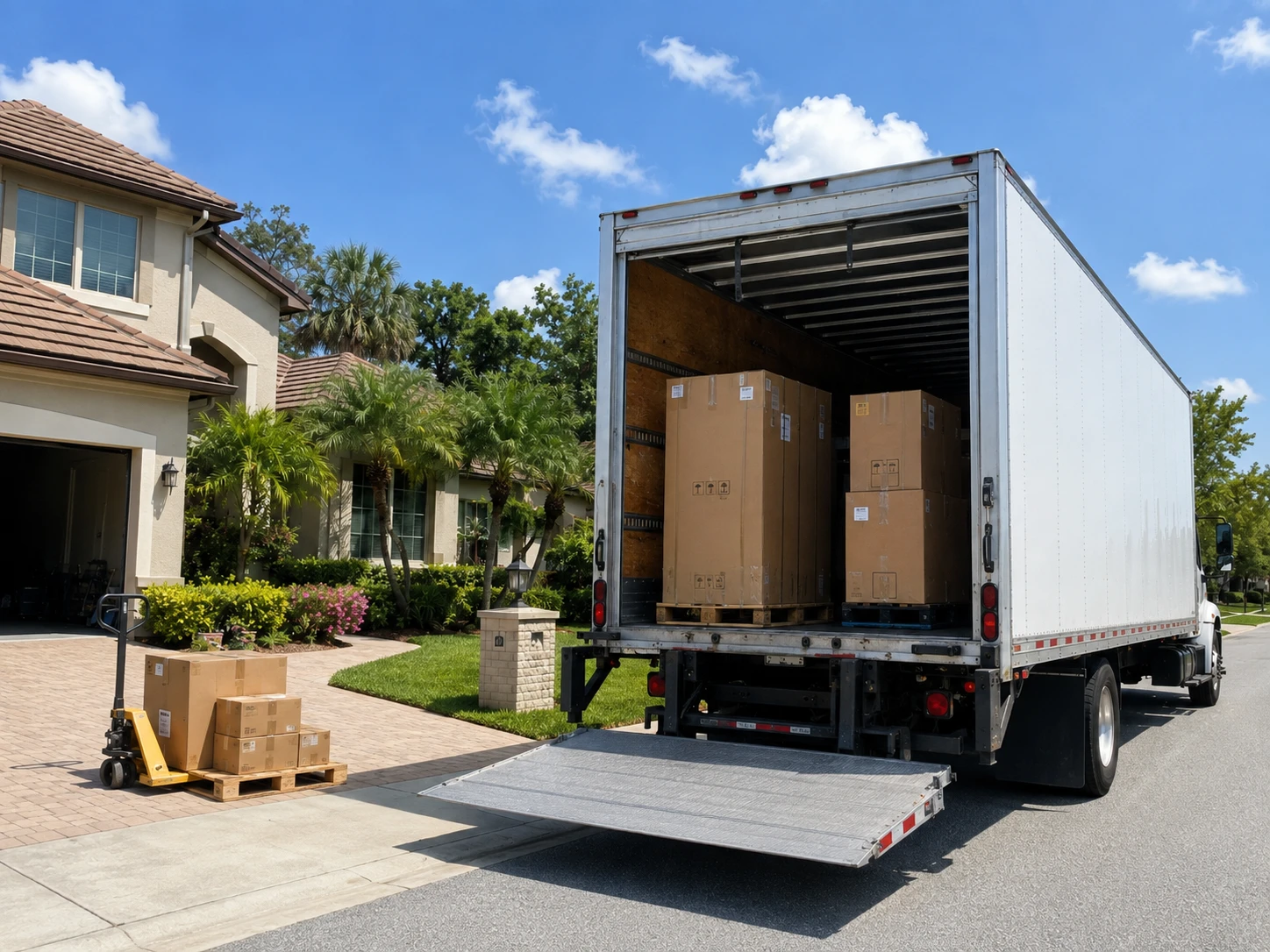
This is what residential and liftgate buy together: a truck that can work the street, and the pallet on the ground. Anything past that point is a separate charge.
The core distinction
Four charges, one journey
Residential, liftgate, and inside delivery are not a package. Each one buys a different stretch of the same trip, and each is priced on its own. Most people assume the first charge covers the whole thing.
- Residential deliveryReaches: On the trailer
A truck that can work your street. The freight is still on the trailer.
- + LiftgateReaches: On the ground, at the curb
The pallet comes down to the ground, at the curb.
- + Inside or threshold serviceReaches: Past the threshold
Across the first ground-level threshold — where a carrier offers it at all.
If there's no dock and no forklift at the address, you need residential and liftgate both. Ordering only residential is how deliveries fail at the curb, and fixing it costs a redelivery.
And a fourth, sitting off to the side: limited access
Not a step along the journey — a different classification of the location itself. Storage units, schools, churches, and construction sites are treated as harder to serve than a standard dock and are priced as their own accessorial. A location can be billed limited access instead of residential, or on top of it. See our fee schedule.
“Residential Delivery service is only to curbside and does not include assembling, packing, unpacking, dismantling, sorting, set-up, or removal.”
Two rules worth reading before you book
It is charged per end, and it can drag a liftgate with it
Often charged at each end — but not always
Four of the carriers we reviewed say plainly that the residential charge applies separately for pickup and for delivery, so a home-to-home move pays it twice. Most tariffs are silent, and Estes writes its item around the consignee, which reads as delivery only. Budget for both ends and confirm on the carrier handling your shipment.
On five carriers the liftgate is not optional
Saia, Estes, A. Duie Pyle, Roadrunner, and Forward Air all attach a liftgate to residential automatically. Estes triggers on any piece of 50 lbs or more, Pyle at 100 lbs, and Forward Air on the neighborhood rather than the shipment. The second charge lands whether you asked for it or not.
“The charges provided in this item will apply separately for pickup and delivery and will be in addition to all other applicable charges.”“Liftgate service will apply on residential pickup and delivery.”
Carrier by carrier
Which LTL carriers deliver to a residence
Not all of them, and not on the same terms. Some won't collect from a residence at all, one has no residential item and prices homes as limited access, and five attach a liftgate automatically. This is where a multi-carrier quote earns its keep — the rules below change what the same shipment costs and whether it can move at all.
Delivers to the front or back door, or the garage
- Liftgate
- Separate charge
- How it's billed
- Flat per shipment
FXF 100-Y, Item 750-2
- Liftgate
- Separate charge
- How it's billed
- Per hundredweight, minimum applies
ODFL 100-Q, Item 753-1
The item is scoped to the consignee — residential delivery, not pickup
- Liftgate
- AutomaticApplied automatically on any piece 50 lbs or more
- How it's billed
- Per hundredweight, minimum applies. A reduced flat rate if you collect at the terminal
EXLA 105, Item 751
Curbside only, stated explicitly
- Liftgate
- AutomaticTariff states liftgate will apply on residential pickup and delivery
- How it's billed
- Per hundredweight, minimum applies
Saia 170-D, Item 753
Higher minimum in parts of Louisiana
- Liftgate
- Separate charge
- How it's billed
- Per hundredweight, minimum applies
ABF 111-AU, Item 751
Highest published minimum and maximum of any carrier reviewed
- Liftgate
- Separate charge
- How it's billed
- Per hundredweight, minimum applies
Item 753-2
Ground-floor entrance, garage, or carport. Higher rate in the NYC metro
- Liftgate
- Separate charge
- How it's billed
- Per hundredweight, minimum applies
UPGF 102-T, Item 753
Front or back door, or inside the garage
- Liftgate
- Separate charge
- How it's billed
- Per hundredweight, minimum applies
CT 100-CB, Item 751-02
Will not perform residential pickups under normal operating conditions
- Liftgate
- Separate chargeLower per-piece weight cap on residential than commercial
- How it's billed
- Per hundredweight, minimum applies
SEFL Item 753
Notification is included in the charge
- Liftgate
- Separate charge
- How it's billed
- Per hundredweight, minimum applies
AAA Cooper 190-AF, Item 753
Notification is charged separately
- Liftgate
- Separate charge
- How it's billed
- Per hundredweight, minimum applies
Dayton 19-K, Item 855
Lowest published maximum of any carrier reviewed
- Liftgate
- Separate chargeFlat, banded by weight
- How it's billed
- Per hundredweight, minimum applies
Pitt Ohio Item 753
No residential item exists — residences are priced as limited access
- Liftgate
- AutomaticApplied automatically on any piece 100 lbs or more
- How it's billed
- Flat per shipment
PYLE 101-U, Item 750-9
- Liftgate
- Separate charge
- How it's billed
- Per hundredweight, minimum applies
Averitt Item 753
Residential pickup only where Oak Harbor originally delivered the freight there. Notification included
- Liftgate
- Separate charge
- How it's billed
- Per hundredweight, minimum applies
OAKH 100, Item 310
Inside service reaches the first floor only. No published maximum
- Liftgate
- AutomaticTriggered by the neighborhood, not the shipment
- How it's billed
- Per pound, minimum applies
Forward Air accessorials
Curbside only, stated explicitly. Notification included. No published maximum
- Liftgate
- AutomaticApplied automatically to all residential pickups and deliveries
- How it's billed
- Per hundredweight, minimum applies
RDFS 100-K, Item 751
Pickup and delivery are defined as service to a business location
- Liftgate
- Separate charge
- How it's billed
- No residential rate published
FRZF 105, Items 3.14 and 3.38
Read from each carrier's own published tariff on August 8, 2026. Tariffs are revised regularly and the tariff in effect at shipment controls — treat this as reference, not a quote.
Taking delivery
No loading dock: four ways to receive it
Residential delivery with liftgate
The standard setup: the driver lowers the pallet to the ground at the curb. Budget for both charges. On a long, steep, or gravel driveway the pallet may end up at the street rather than at the door.
Pick it up at the terminal
Collect the shipment yourself from the carrier's local terminal. This avoids the residential charge and the liftgate charge, because you're loading from a dock with a forklift — Estes prices terminal collection at a small flat rate instead of the full residential charge. You'll need a suitable vehicle and usually a second set of hands, but on a heavy pallet it can save a few hundred dollars.
Deliver to a business instead
If a local business with a dock will receive it for you, a commercial delivery avoids the residential charge. Use a standard commercial address — a self-storage facility or similar site carries a limited-access charge of its own. Confirm the receiver has agreed and will be there; a failed delivery costs a redelivery fee.
Move up a mode
Above roughly 28 linear feet or 20,000 lbs, compare partial or full truckload — often cheaper, handled less, and easier to schedule to a residence.
Get LTL rates for your lane
Multi-carrier LTL quotes with transparent pricing — compare options before you book.
Keeping the invoice honest
Why a corrected invoice shows up weeks later
Corrected LTL invoices nearly always trace to one of three things — all of which you control at quote time.
An undeclared accessorial
If residential, liftgate, or limited access wasn't on the bill of lading and the driver provided it anyway, it's billed afterward — and those charges usually stand, because the service was performed.
A reweigh
Terminals weigh freight on certified scales. If the actual weight is higher than what you declared, the shipment reprices at the real weight and a reweigh fee is added.
A reclass or reinspection
Dimensions drive density, density drives freight class, and class drives price. Measure the loaded pallet including the pallet itself, to the highest and widest points.
Have these ready before you quote
- Exact pickup and delivery addresses, and whether each is a home, a business, or a limited-access site.
- Total weight including the pallet and packaging, and the loaded dimensions to the highest and widest points.
- What the freight actually is — the commodity drives the class.
- Whether there's a dock or forklift at each end. If there isn't, that end needs a liftgate.
- Whether anyone will be there to receive it, and any window constraints.
Our service fee schedule lists what we charge for each accessorial, so you can price them in before you book.
At the curb
Damage, signatures, and what you are covered for
Residential shipments move through the same network as commercial ones — handled several times, riding alongside other shippers' freight. Two things decide how a damage claim goes, and both are settled before you sign the delivery receipt.
Inspect before you sign
A clean signature tells the carrier the freight arrived in good order, and anything you find afterward becomes a concealed-damage claim — much harder to win. Walk the pallet, look at all four sides, and write what you see on the receipt before you sign: “carton crushed, top right,” not just “damaged.” Photograph the freight on the truck if you can. If the damage is severe, you can refuse the shipment.
Our guide to what to write on a delivery receipt has the exact wording that holds up, and if something does go wrong, our freight claims process covers what to file and what documentation you need.
Coverage is by weight, not value
Carrier liability is released value — calculated from the weight of the freight, not what the item is worth — and used household goods are frequently capped at $0.10 per pound or excluded entirely. A 600 lb item at that rate is covered for $60. That's liability for carrier negligence, not insurance on your goods.
Our LTL liability guide breaks the limits down carrier by carrier. If the freight is worth more than its weight, add separate cargo coverage before it ships.
Common questions
Residential freight delivery FAQs
Quote it with the accessorials included
Tell us it's a residence and we price residential and liftgate into the rate before you book. The full quote form also covers limited-access sites and inside delivery.
Quick pallet quote covers residential and liftgate. For limited-access locations or inside delivery, use the full quote form.